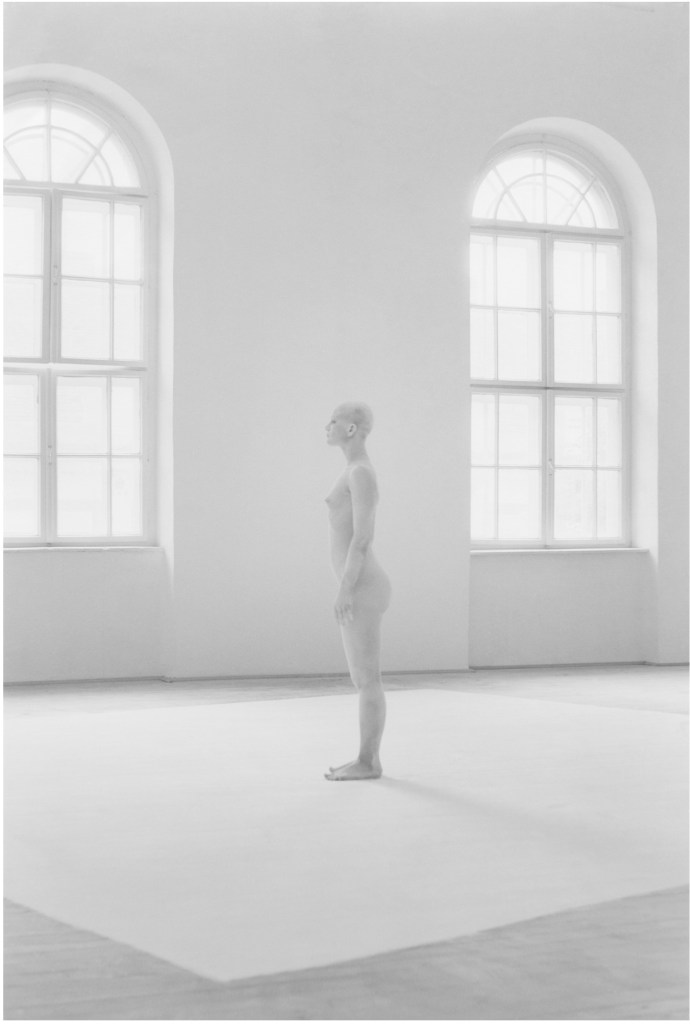
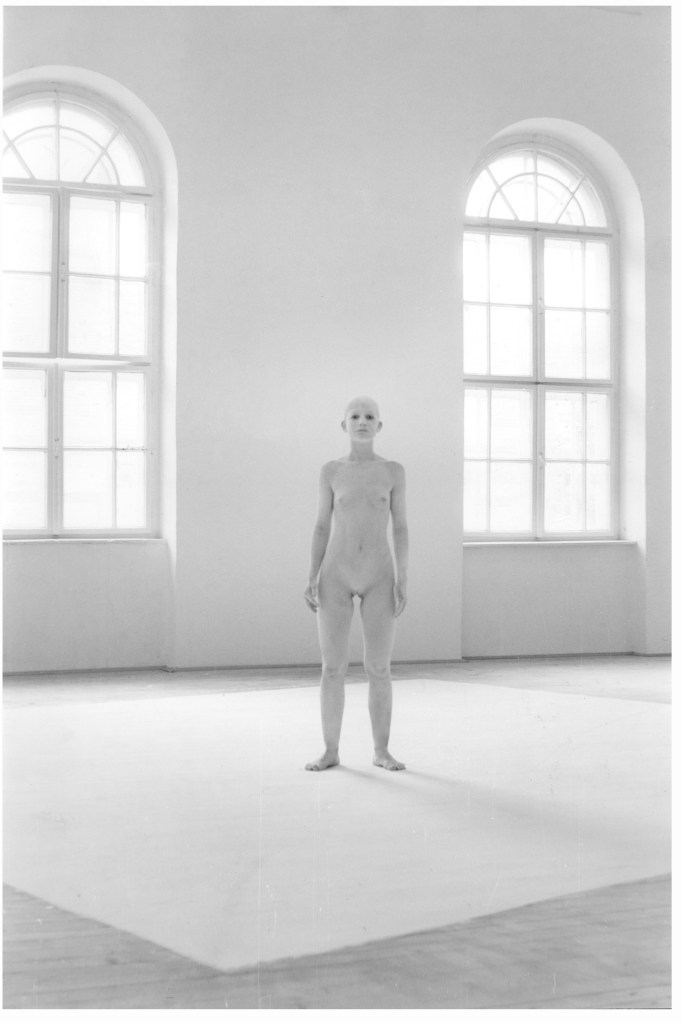
Personal Space is a static performance incorporating original sound and video material. Performed on the occasion of Manifesta 2, European Biennial of Contemporary Art, inside the Elevator of the Musee d’Histoire de la Ville de Luxembourg (City Museum), June 26/27/28, 1998, for one hour on each day. Inside the spacious elevator, I had placed a square of non-affixed white marble powder in which I stood, with my head and body shaved and covered in marble dust. The audience was able to use the elevator as usual (pressing the buttons on the control board, entering and exiting at the desired level), or to remain in it for as long as they wished, given my performance. Thus, the audience could see me only in a static position in the chosen space. After the performance ended, the elevator went back into regular use, carrying the sound that marked the space, the sound that describes silence, composed specially for this work by Vladimir Radonjić This gentle, anxious sound-landscape was able to reflect my perturbed soul. The viewing of the performance Personal Space was possible for the duration of Manifesta 2 with the use of existing museum equipment for transmission of documentary video: liquid crystal display monitors on each floor of the museum, next to the elevator.
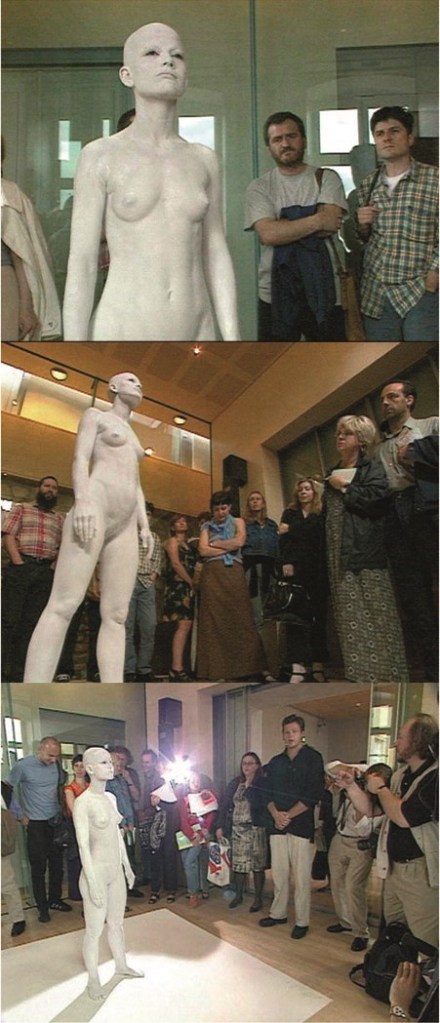
«In this performance Tanja Ostojić has critically evoked spiritual visions of the body from the medieval spiritual tradition and combined two aspects: nuditas naturalis and nuditas virtualis. Her body, purified of bodily hair, covered by marble powder, has been transformed (being a tableau vivant) into an image as folding of the outside into the inside. The question is how such a static act (Tanja Ostojić does not move her body throughout the whole performance) manages actually to «perform». The body communicates through movements, and the lack of these body techniques suggests an agonising position that is monumentalised. This performance, being a tableau vivant, is not «only» a living sculpture (in the manner of 1970s art) but rather a living monument carrying in itself all the pomp and the historical symbolic weight associated with such gestures of grandeur. In a position where the beholder fixes his/her gaze on a body vulnerably exposed, s/he witnesses not only a mute statement of the indisposition of an artist to act within a hostile environment (for someone living in Serbia this carries the double weight of an internal/local and external/international isolation of a subject-in-opposition) but also discloses the wider image of woman’s body in art history as a sad affair of symbolisation and manipulation.»
(Branislav Dimitrijević, in: Manifesta 2, exhib. cat., Luxembourg, 1998.)
…………………………
Spiritual square
Personal Space was the first significant project with which Tanja Ostojić reflected the legacy of avant-garde, radical performance and body art, focusing at the same time on the artists inner being, space that it occupies and its psychological dynamics. She started using her body as a medium of expression and it appeared that in this performance she absorbed the firmness and motionless of the marble. Standing on the square of white marble dust, her body emanated an solemn space of inner calmness reserved for the artist, evoking on the other hand the ‘auratic’ space of Malevich’s Suprematism. Her work was at the same time introvert and extrovert – while trying to mark a private, even intimate space, she was exposing herself, her naked, shaven body to the eyes of the viewers. To claim the right for the impenetrable personal space which determines artists identity, she needed to enter the silent communication and dialogue with the audience. Once established this ambivalent shifting between the dichotomies of inside / outside, introvert / extrovert, private / public, will keep appearing in her further project. (…)
The performance Personal space, was first presented at the Biennial of Young Artist held in Vršac, in 1996, in the time when Serbian society just passed the period of most severe isolation due to the sanctions of UN. The circumstances under which artist worked were underlined as the paradigm of the art in the closed society where the most frequent strategy was withdrawal from the social sphere and dedication to the introspective work and reflection of the aesthetical issues in art. The mid-nineties were crucial phase when some of the most prominent Serbian artist started to shift the emphasis of their work towards more critical and engaged reaction to the socio-political frame that was so strongly determining the conditions in which they worked. In this context, Ostojić’s project was one of the rare to take a more radical statement, though still in the frame of artistic problems that had strong heirs in the circle of conceptual artists formed in the Students Cultural Center in Belgrade in the 70’s, Marina Abramović being one of the globally most acknowledged. Without any doubt the need of the artist working in the economically collapsed and torn by wars country was to define her own position, her own identity and her own attitude towards the social reality. However, as the artist claimed the dynamic of this work was above all interior. With the standpoint to make always strong statement with her work, one small step was needed to get from the realm of introvert meditative treatment of her body into its more engaged placing in the social and political sphere. The work of Ostojić from this point had started to engage more actively with the issue of blurring and crossing of the social, political, economic boundaries.
Social square
Another segment of the project Personal Space was the photo album done with Sasa Gajin. It recorded the different inscriptions of the square onto Ostojic’s body, from white positive and black negative on her shaved head to the shaved square on her Venus Hill. The same black square of Malevich reappeared again in projects Black Square on White and I’ll be your angel conceptualized for the Biennale of Venice in 2001. Taking up the role of the escort, a “guardian angel” of the curator of the Venice Biennale, Harald Szemann Ostojic again used the twofold strategy. She was exposed all the time to the audience, actually got all the public attention being constantly au pair with the “most wanted and desired” person of the Biennale but another part of her project, the Malevichs square on her Venus hill was reserved just for the sight of Mr. Szeemann. (…)
(Dr Erić, Zoran: “Personal Space – Public Body”, in Artefact, Zagreb, 2003.)
 TANJA OSTOJIĆ