durational project / combined media installation

In August 2000 I started the Looking for a Husband with EU Passport project. After publishing an “ad” with this title, I exchanged over 500 letters with numerous applicants from around the world. Following a six-month correspondence with a German man, K.G., I arranged our first meeting as a public performance in the field in front of the Museum of Contemporary Art in Belgrade (November 28, 2001). One month later we officially married in New Belgrade. With the international marriage certificate and other required documents I applied for a visa. After two months I got one entrance ‘family reunification visa’ for Germany, limited to three months, so I moved to Düsseldorf where I was officially based for three and a half years. In spring 2005 my three-year permit expired, and the authorities granted me only a two-year visa. After that K.G. and I got divorced, and on the occasion of my Integration Project Office exhibition opening in Gallery 35 in Berlin on July 1, 2005, I organised the Divorce Party.
(T. Ostojić, Wall text accompanying the installation)
Further information and book orders:
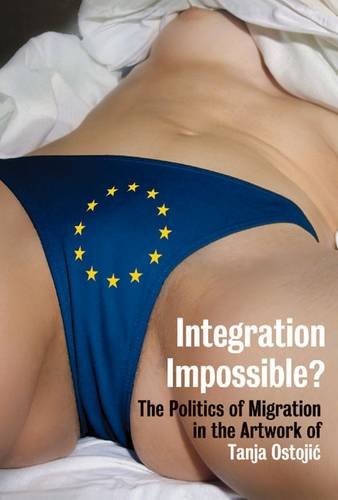
In her situationist performances, Tanja Ostojić (*1972 Belgrade) not only uses her body, but also her life. The works such as Looking for a Husband with EU-Passport, Crossing Borders Series and Naked Life, include various current aspects of migration and simultaneously touch on feminist themes. The contributions in this book come from authors and critics from the Balkan region as well as from Europe and the USA and also explore Ostojić’s themes from historical, political, sociological and human rights perspectives. Numerous color illustrations and short descriptions of the works and transcripts of discussions complement the essays.
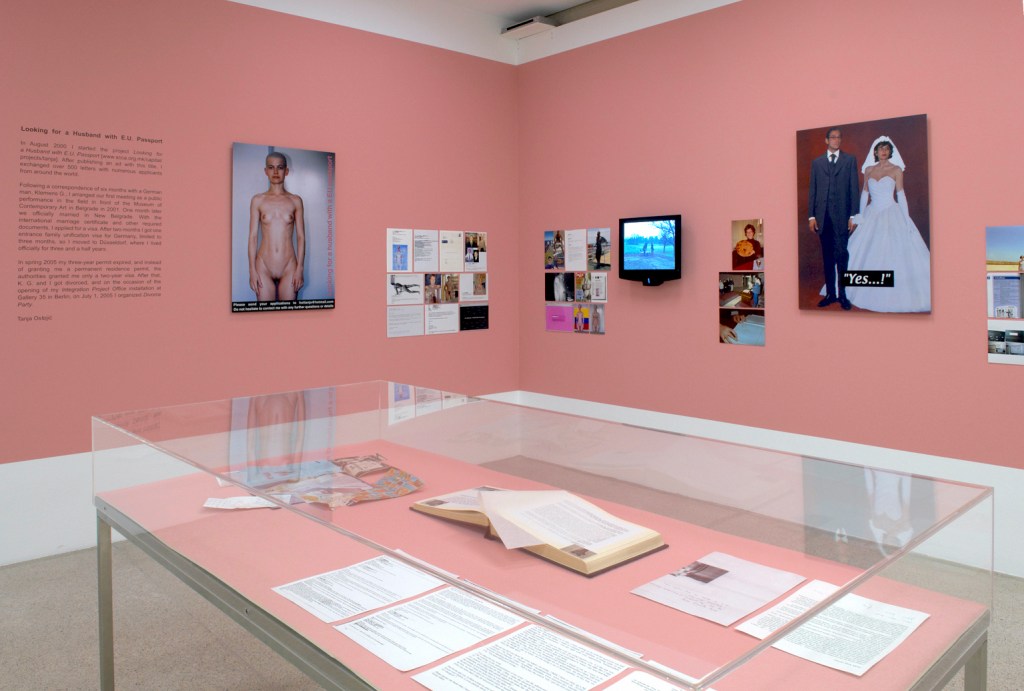

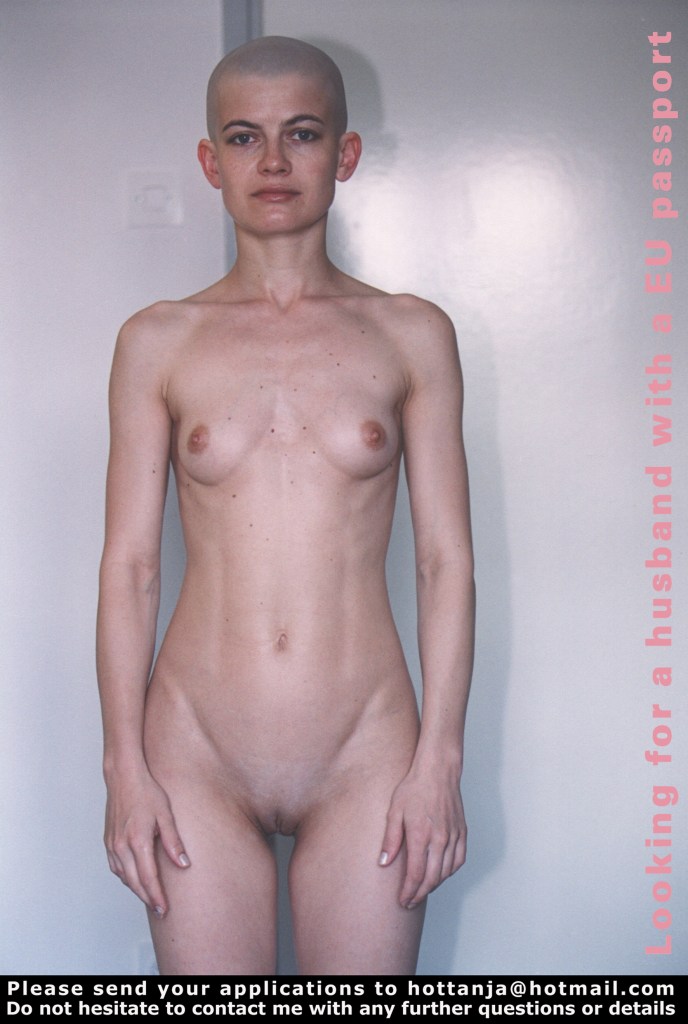
Looking for a Husband with EU Passport was a very complex five-year-long project, which consisted of different stages in which I exchanged hundreds of emails and a number of physical letters, with people from around the globe. Eventually, I reached the point where I thought that the next step in the project’s development would, indeed, be a marriage. The work organically progressed from net art, via live performance, to law — including a legal marriage and divorce — and finally, an archival art installation. Law is often enforced arbitrarily; therefore we need to look at who has written it and whom it serves. We cannot take law for granted. Obeying the law is very important, however, it is equally important to question it, and with this project, I especially questioned the ethical aspects of EU immigration laws. I looked into the ways it, in effect, intersects with my non-EU origin and with my gender. In particular, as in many of my later works, I delved into the fragility of the female condition in the context of migration. The issue of whether the marriage has been implemented or not, in the case of EU and non-EU partners, is what the authorities are most curious about. It was a very complex and delicate situation, to be honest, and we needed to be precocious about several legal aspects of married life. The project was critical of Schengen Agreement bio-politics, which have, for decades, left me feeling extremely exposed, vulnerable and discriminated against, because of the discomfort that arose at having my private life exposed against my will. (Tanja Ostojić: “LAW”, in The Nineties, A Glossary of Migration, exhib. catalog, Museum of Yugoslavia, Belgrade, 2020)
Looking for a Husband with EU Passport installation is a part of the contemporary art collection of the Moderna Galerija MG+MSUM Ljubljana, Slovenia. This, theoretically highly referential and one of the seminal art projects by T. Ostojić, has been also included it the list of „The best art of the 21st century“ by the british Guardian.
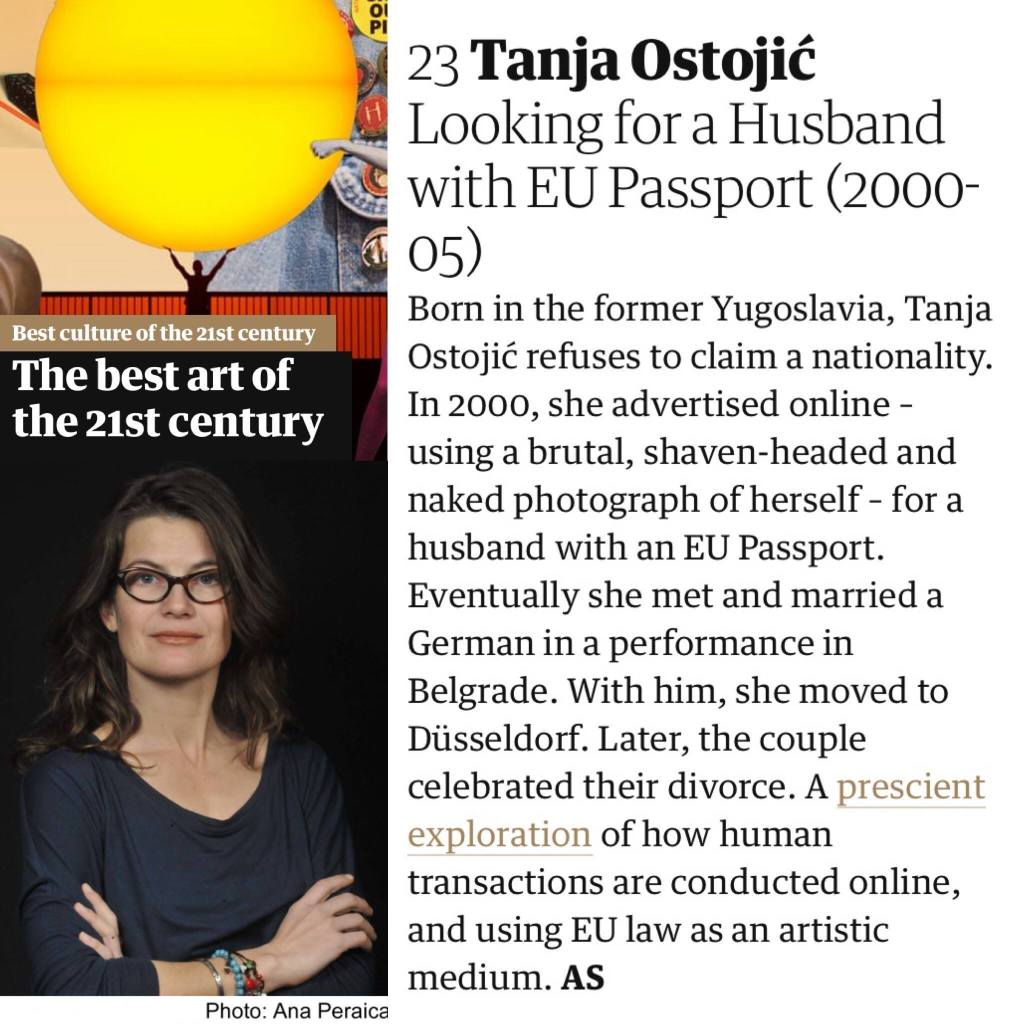
This project is a part of Crossing Borders Series (2000-2005) along with Illegal Border Crossing (2000) and Waiting for a Visa (2000), by Yugoslav born artist Tanja Ostojić.
 TANJA OSTOJIĆ