Black Square on White, made of pubic hair on my Venus Hill, allowed me to reconstruct a previous artwork (from the Personal Space photo-series 1995-96) in the context of the Plato of Humankind, 49th Venice Biennale. Only the Biennale director, Mr. Harald Szeemann, had the right to see this “hidden Malevich” in order to declare it an official part of the exhibition. Walking around Venice during the preview days, elegantly dressed my Black Square on White- conceptual body art work stayed hidden. With the direct reference to the Kasimir Malevich´s suprematism – the first avantgarde of the 20th century – as well as to the questioning of the commodification of it, posed by Alexander Brener´s dollar-sign-gratify intervention over Malevich´s White Cross on White in the Stedelijk Museum Amsterdam, I was questioning western man´s interpretation of the art history and the lack of space for the eastern european women artist in it. I was hoping my work could provoke as well the rethinking of the importance of non-material ideas and non commodified values within the contemporary art system.
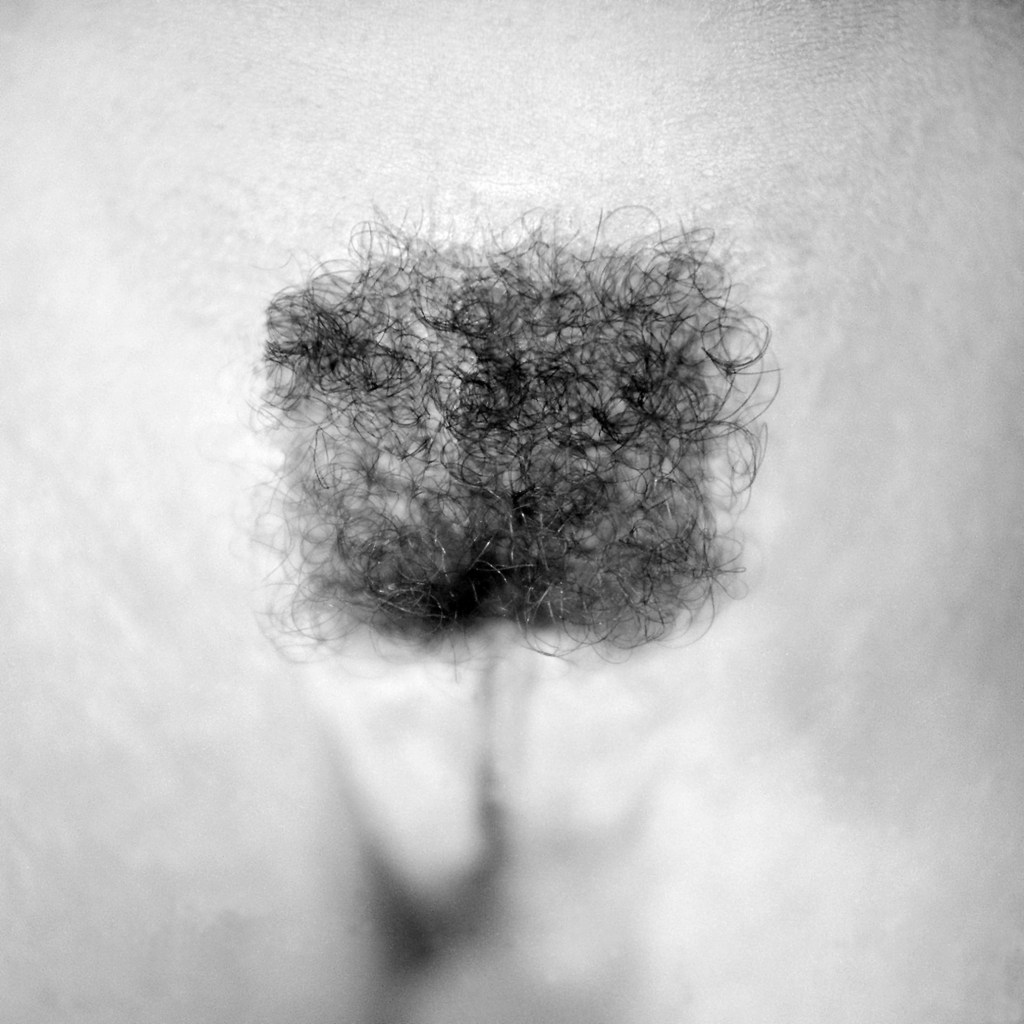
Conceptual Body Art Work, Plato of Humankind, 49th Venice Biennale, 2001 / Hand developed B&W photo on matt photo paper 40 X 40 cm + vinyl lettering in the same size. Photo: Sasa Gajin. Copyright: Tanja Ostojić
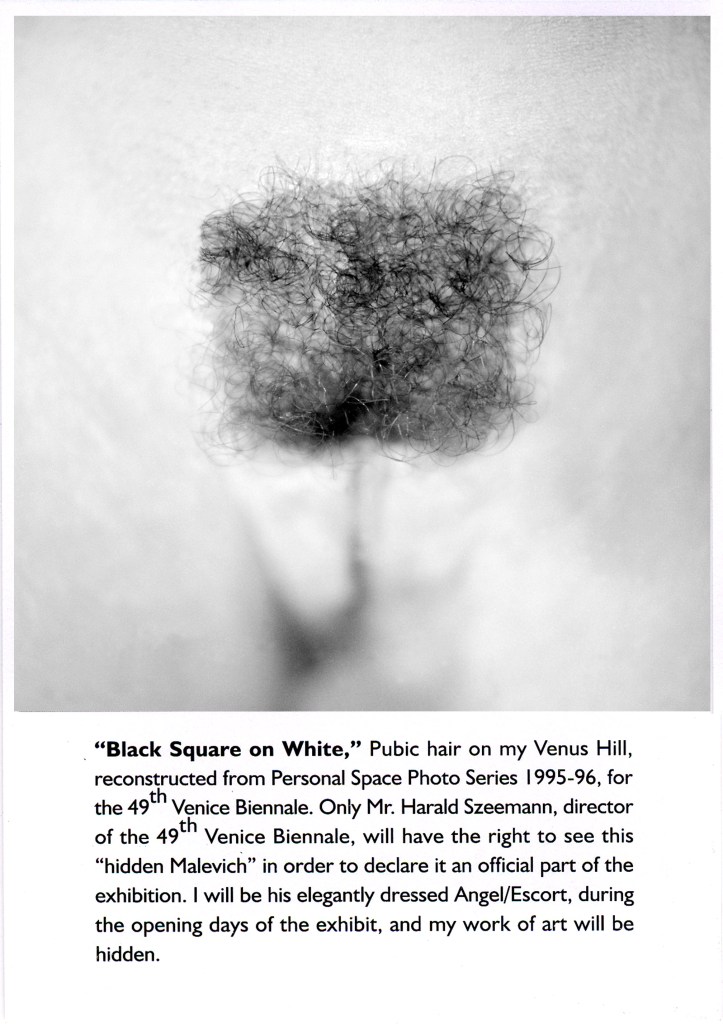
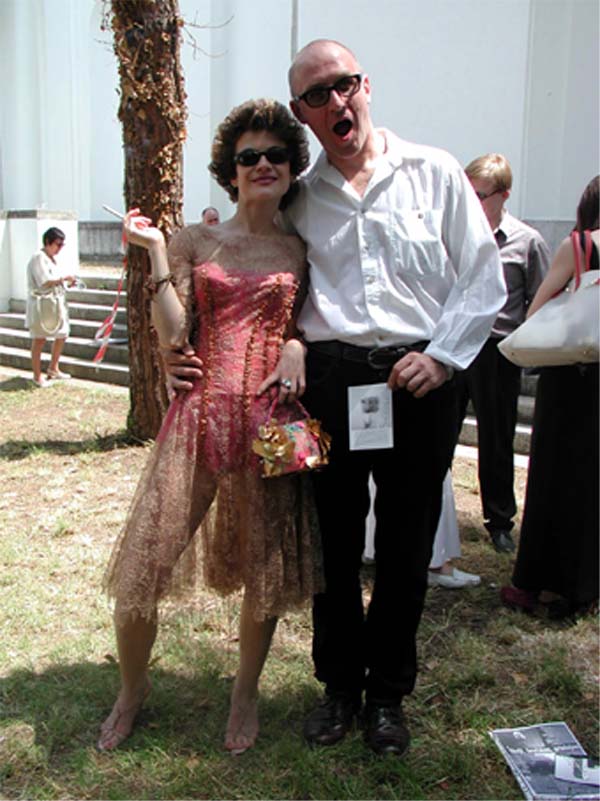
During the 49th Venice Biennial, in contrast to the enormous proliferation of events that were taking place simultaneously and thus remained inexperienced by many, there was one performance that was accessible to only one chosen visitor. The project in question was conceived as un-accessible and invisible to anybody else but Harald Szeemann – the main selector of the Venice Biennial and the work itself consisted of the “Venus Hill” of Tanja Ostojić shaved in a shape of a square instead of the natural triangle.
The project “Black Square on White” (2001), is difficult to be defined as performance, installation, object or any other medium in the usual sense of these terms, as applied by art criticism and theory. Several conditions for a performance are to be questioned here in order to clarify why the presumption that this work expands the field of the medium of performance was made at first place. Namely, the actual moment when the only visitor was allowed to “visit”, to see the “work”, was not announced within the agenda of the Biennial. The “hidden agenda” raises many doubts about the actual event: whether it really happened, when and under what circumstances and whether the work really exists at all. The narrativity of invisible and possible instead of the narrativity of transparent and vulgar provoked the equillibristics between the secret and obscenity that continuously amuzes the audience, even after the three days of the official uncertainty.
The selector was forced to select the work without seeing it – only as a proposal. But what was there to be seen, anyway? The scene, the image referring to the famous Malevich’s paining with the same title is one of the most radical appropriation, a blasphemous parody of the icon of modernism. Simultaneously, the parody touches upon the stereotype of the gender symbolization. This complex play between the minimalism and contextualism, between the public and the private space of the artist and between the appropriation as affirmation and the feminist critique of modernism as parody, are only few of the important vantage points of this work.
The spectacle of the invisibility, the secrecy of the performance, re-enforced the obscenity of the hypothetical event of “apocalyptic” execution of the work: the “revelation of truth”. This hypothetical moment of “stripping the clothes off” has attacked the position of the curator/selector as the main authority of the most prestigious world art institution in a very weird fashion. The power of the curator in the art scene hierarchy is disturbed by the simple fact that the objectivity in selection is based on the personal ethics and any hint for a personal relation between the artist and the curator is usually a starting point for such ambivalence.
The mere fact that Harald Szeemann has selected and allowed the project as it was originally conceived gives way to interpret his readiness to accept to play this tricky power-game with field of phantasmatic either as an act of arrogance of the “untouchable” or, more likely, as a desire to remain open to all possible provocations that could come from the young artists, doesn’t matter whatever problems they might cause. In both cases Ostojić succeeded in her courageous “challenge to a duel”.
(Dr Milevska, Suzana, “Spectacle of Invisible”, NU – Nordic Art Review, vol. III No. 5/2001, pp.60-61.)
 TANJA OSTOJIĆ